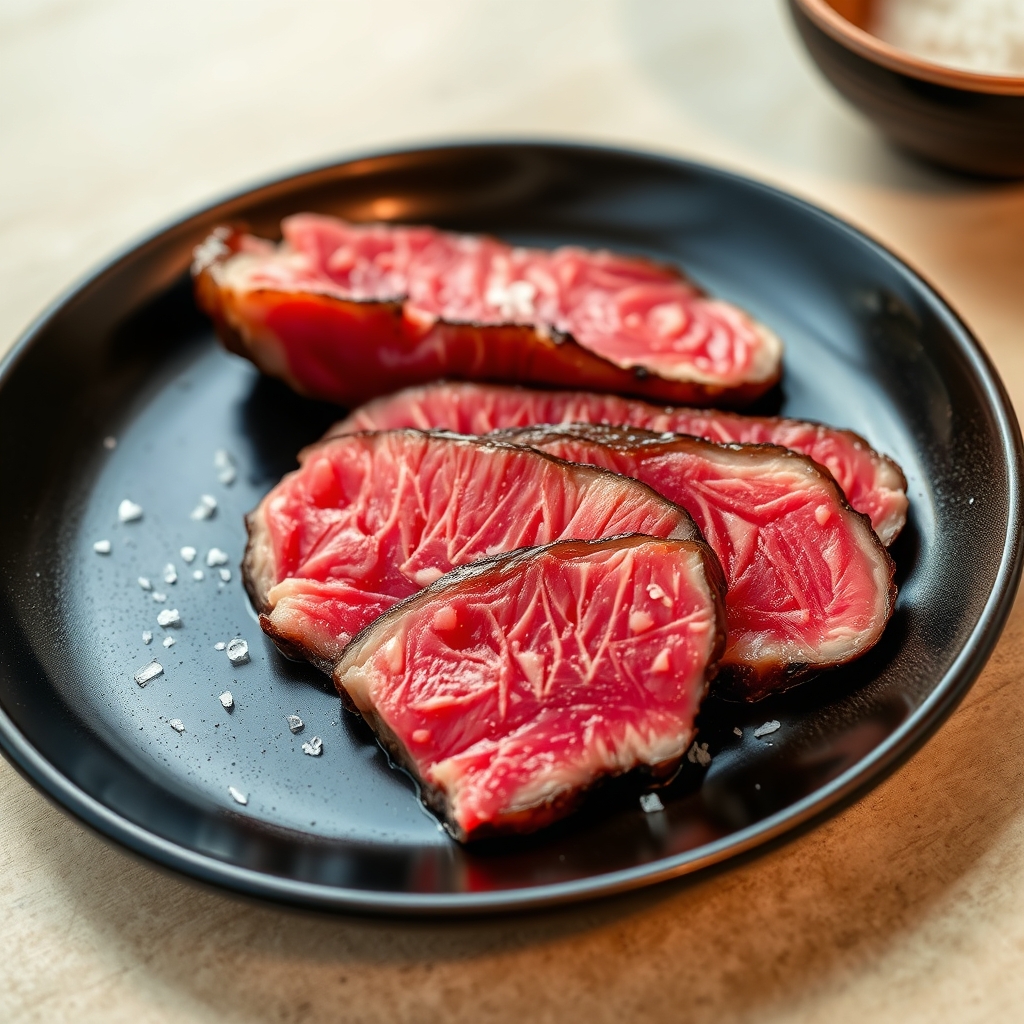
Order A5 wagyu expecting a steak and you will probably be disappointed. The fat content is so high that a full-sized portion becomes greasy after five bites, and the texture is closer to soft butter than to beef. Order it expecting a small, rich course and it becomes one of the most memorable things you can eat.
What the grades mean
Japanese beef is graded on two scales. Yield grade (A, B, C) describes how much usable meat the carcass gives. Quality grade (1 to 5) covers marbling, colour, firmness and fat quality. A5 is therefore the highest of both — but a high grade is a measurement, not a flavour guarantee.
Marbling is scored separately on the BMS scale from 1 to 12. Most export A5 sits between 8 and 12. Above 10, the beef is so fatty that many Japanese chefs prefer to serve it as sushi or in very thin slices rather than as a steak.
Why it tastes sweet
- Oleic acid. The fat in Japanese Black cattle is high in monounsaturated oleic acid, which melts at a low temperature and tastes mild rather than beefy.
- Long feeding. Cattle are typically raised for 28 to 30 months or more, which builds the fine web of intramuscular fat.
- Genetics. The breed was closed to outside bloodlines for most of the twentieth century, so the marbling trait is unusually consistent.
- Regional brands add rules. Kobe, Matsusaka and Omi each set their own requirements for origin, feed and grading, and each carries its own price premium.
How to cook and order it
Thin slices on a yakiniku grill, thirty seconds a side, dipped in salt or a light soy-based tare. Sukiyaki, where the beef simmers briefly in a sweet soy broth, is arguably the better use: the fat flavours the liquid and the vegetables carry it. Teppanyaki is the theatre option, and the quality is usually high but the price is highest.
If you are buying to cook at home, ask for a cut with a visible certificate and a known farm. A kilogram of A5 that arrives without paperwork is likely crossbred wagyu, which can be excellent but should cost a third as much.
The correct portion of A5 is smaller than you think — 100 to 150 grams per person, with rice and pickles. The mistake almost everyone makes is ordering 300 grams because the price suggested scarcity rather than richness.
Where to eat it
Tokyo and Osaka have the widest choice, from cheap yakiniku chains to counters that serve a single farm's beef. Matsusaka in Mie Prefecture and Omi in Shiga Prefecture are worth a detour if you want to eat the beef close to where it was raised; the restaurants there are less expensive than their Tokyo equivalents and often more generous.
Outside Japan, price tracks certification closely. A restaurant that can show the certificate will usually be proud to, and one that talks about "A5" without paperwork is selling a grade, not a brand.
Is it worth planning a trip around?
A proper wagyu meal is worth doing once, in Japan, at a place that specialises. It is not worth paying a premium abroad for a cut you cannot verify. And it is worth remembering that the best beef most Japanese cooks eat is a modest B4 yakiniku cut, not the trophy A5.
Source: Wagyu on Wikipedia, and Japan's Ministry of Agriculture, Forestry and Fisheries.
A5 tells you how the carcass scored. Kobe, Matsusaka and Omi tell you where and how it was raised. The brand is the stricter promise.
Use the TasteBridge finder to see local dishes, bakery, cafe plates, coffee and everyday drinks, with rough price bands and dietary filters.
Open Japan in the food finder