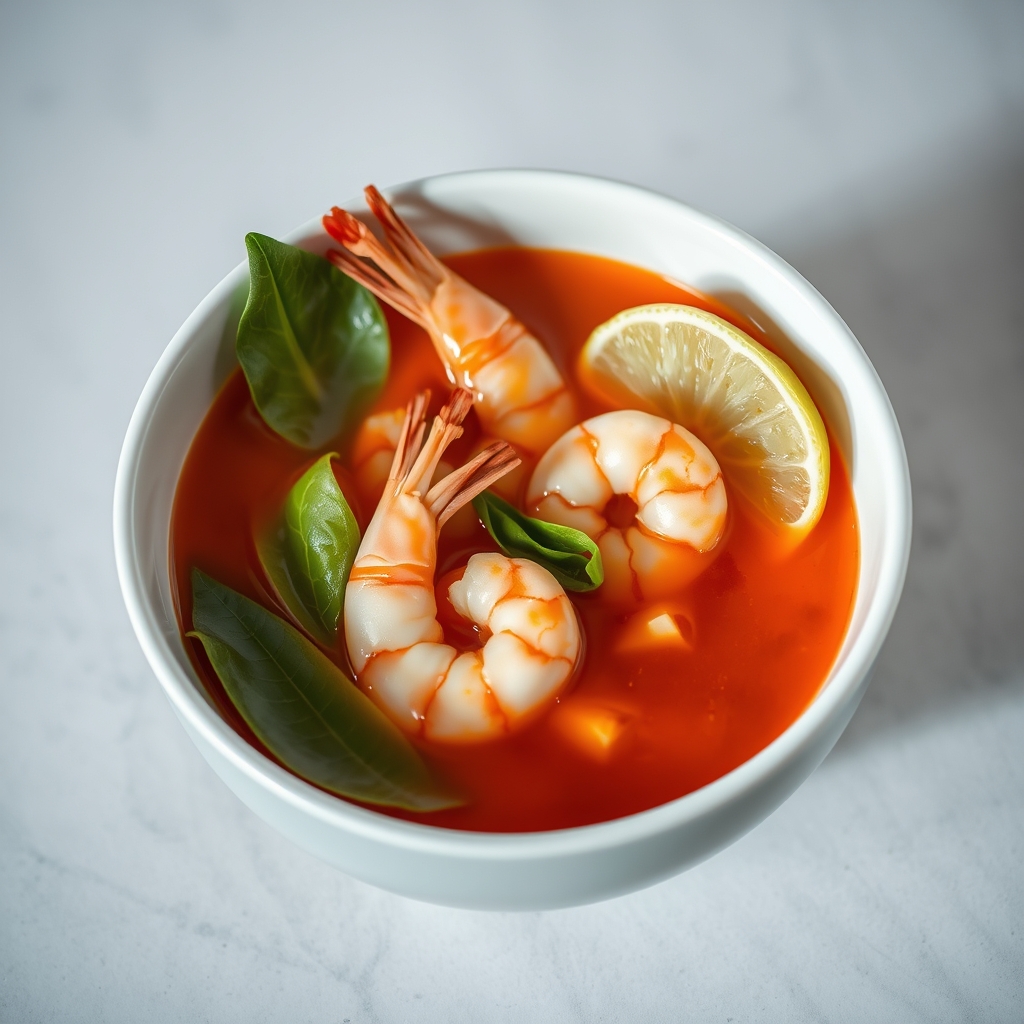
Thai cooks describe tom yum as a balancing act rather than a recipe. The broth should hit sour first, then hot, then salty, then a small sweet note underneath. The ingredients are few and the order matters: aromatics go in early, prawns go in late, lime juice goes in after the heat is off.
What tom yum actually is
The name roughly means "boiled mix". At its base it is water or stock, bruised lemongrass, sliced galangal, torn lime leaves, chillies and fish sauce. The prawn version adds whole prawns, usually with the heads on, which is where a lot of the sweetness comes from. Mushrooms — straw or oyster — are standard.
Two versions matter. Tom yum nam sai is clear and sharp, closer to the older style. Tom yum nam khon is "thickened", usually with evaporated milk and a spoon of roasted chilli paste (nam prik pao), and it is the version most tourists meet first: creamier, milder, and sweeter.
Why it tastes so bright
- The acid is added last. Boiling lime juice makes it taste dull and slightly bitter. Restaurants squeeze it in at the table or just before serving.
- Galangal is not ginger. It is sharper, more medicinal, and it is what gives tom yum its distinctive aroma. Sliced thin and left in the bowl, it is not meant to be eaten.
- Roasted chilli paste adds depth. Nam prik pao brings smoke and sweetness, which is why the creamy version tastes rounder rather than simply hotter.
- Prawn heads carry the fat. Crushing them slightly in the broth releases flavour that the tail meat alone cannot provide.
Where to eat it
Bangkok's food courts and market stalls serve excellent versions for a fraction of restaurant prices, often with a plate of rice on the side. In the south, the soup is sharper and heavier on lime; in the north, it is often milder and served with sticky rice.
Outside Thailand, a good sign is a menu that offers both the clear and the creamy version. A kitchen that only makes the milky one is usually compensating for a weak stock.
If the soup arrives already tasting of lime but not of lemongrass, the aromatics were boiled too briefly. If it tastes of lemongrass but not of lime, the juice went in too early. Both mistakes are common, and both are fixable at the table.
How to order it
Ask for "nam sai" if you want the clear version, and "mai sai nom" (no milk) if the menu only lists the creamy one. Say "pet nit noi" for mild heat — the default in a local restaurant is not mild. Order rice separately; the soup is not meant to be a full meal on its own.
If you are cooking it at home, use frozen prawns with heads if you can find them, and do not simmer the broth for long after the prawns go in. Three minutes is enough; longer turns them rubbery.
Is it worth planning a trip around?
It is worth ordering on the first day of any trip to Thailand, because it tells you how the kitchen cooks. A restaurant that balances tom yum properly will usually get everything else right too — and at market prices, you can test the theory several times before dinner.
Source: Tom yum on Wikipedia, and Tourism Authority of Thailand.
Aromatics first, protein second, seasoning third, lime last. If a recipe tells you to add lime juice with the stock, it is wrong.
Use the TasteBridge finder to see local dishes, bakery, cafe plates, coffee and everyday drinks, with rough price bands and dietary filters.
Open Thailand in the food finder